Crystalloid Co-loading versus Ondansetron Effect on Hemodynamic Stability of Cesarean Section Patients Anesthetized by Subarachnoid Block in Karbala, Iraq
DOI:
https://doi.org/10.47419/bjbabs.v7i1.435Keywords:
Subarachnoid Block, Hypotension, Bezold-Jarisch ReflexAbstract
Background: Subarachnoid block-induced hypotension and bradycardia remain a frequent and
clinically significant complications during cesarean section. Strategies such as fluid co-loading and ondansetron have been employed to mitigate these effects, but their comparative effectiveness remains under investigation.
Objective: To compare the effectiveness of 8 mg IV ondansetron versus 500 mL crystalloid co‐
loading in reducing subarachnoid block-induced hypotension and bradycardia.
Methods: A prospective randomized comparative study carried out in the Gynecology and
Obstetrics Hospital, Imam Al-Hassan Al-Mujtaba Teaching Hospital, Gynecology and Obstetrics
Department, Karbala, Iraq from October 2024 to March 2025. A total of 180 women were
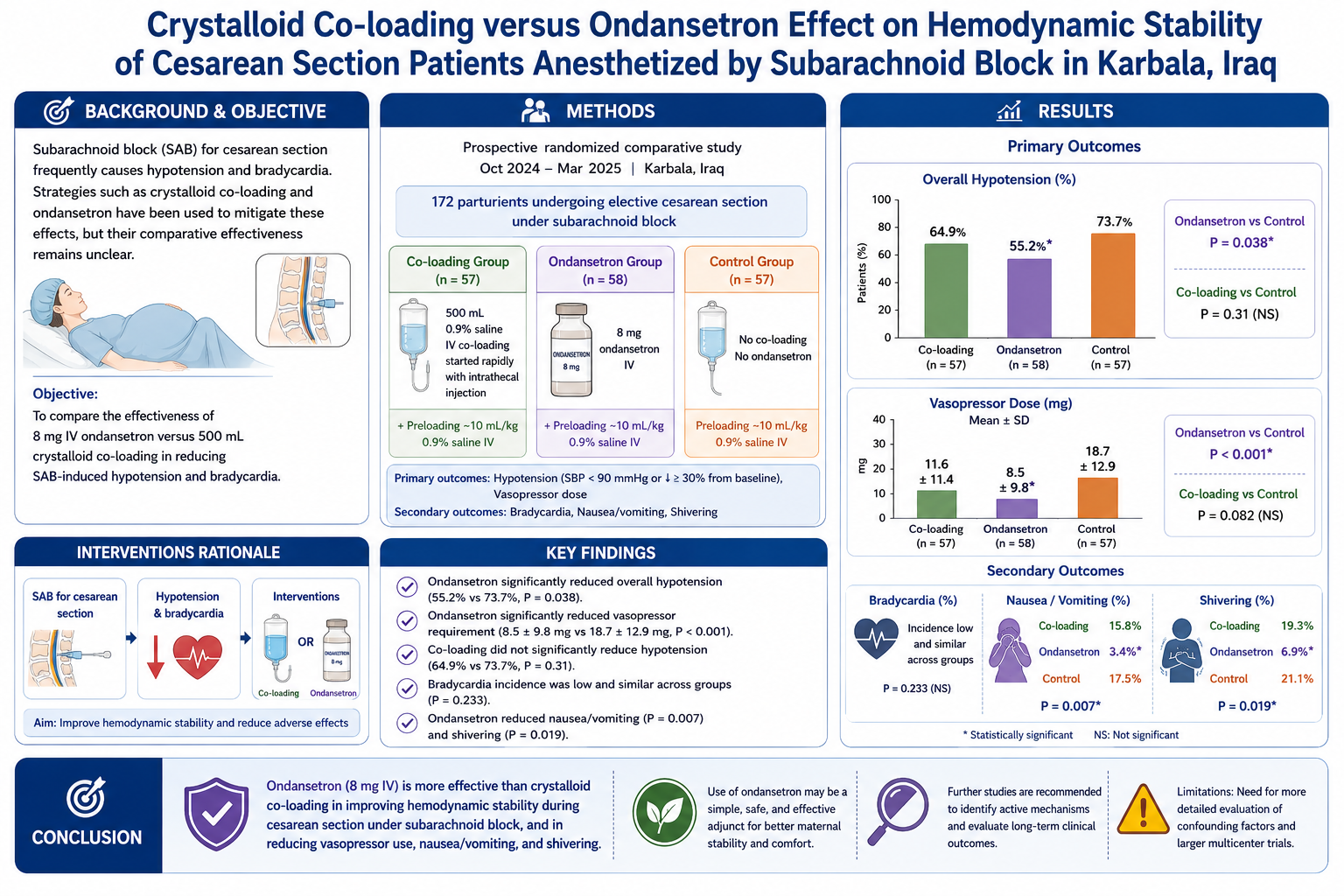
assessed for eligibility, and only 172 were included and allocated into three groups: the co-loading group (57 women) received 500 mL saline solution 0.9% IV starting rapidly with intrathecal injection of local anesthesia; the ondansetron group (58 women) received 8 mg of ondansetron IV and both intervention groups (co-loading and ondansetron) received preloading ~10-mL/kg saline solution 0.9% IV; and the control group (57 women) received only preloading ~10-mL/kg saline solution 0.9% IV.
Results: Ondansetron reduced the overall hypotension from 73.7% (control) to 55.2% (P = 0.038) and vasopressor dose from 18.7±12.9 mg to 8.5±9.8 mg (P < 0.001). Co-loading did not significantly reduce the overall hypotension (64.9%, P = 0.31). Bradycardia incidence was low and similar across groups (P = 0.233). Ondansetron also reduced nausea/vomiting (P = 0.007) and shivering (P = 0.019).
Conclusion: Ondansetron demonstrated superior effectiveness in reducing subarachnoid block-induced hypotension, vasopressor use, intraoperative nausea/vomiting, and shivering, compared to crystalloid co-loading.
Downloads
Additional Files
Published
Issue
Section
Categories
License
Copyright (c) 2026 Ali Abdulameer Kareem Kareem, Haidar Nassir Mohammed

This work is licensed under a Creative Commons Attribution 4.0 International License.
The authors retain all proprietary rights, including copyright, such as patent and trademark rights and rights to any process or procedure described in the article.