Relationship of Monocyte Chemoattractant Protein-1 (MCP-1) with Some Biochemical Parameters in CKD-5 Stage Patients
DOI:
https://doi.org/10.47419/bjbabs.v7i1.420Keywords:
monocyte chemoattractant protein-1, end-stage renal disease (ERSD), biochemical markers, acute inflammation, chemokinesAbstract
Background: Monocyte chemoattractant protein-1 (MCP-1) is a pro-inflammatory chemokine increasingly recognized as a biomarker in chronic kidney disease (CKD). Its novelty lies in linking inflammation with renal dysfunction and mineral metabolism disturbances. However, its clinical utility in advanced CKD is not fully established.
Objective: This study evaluated the association of serum MCP-1 with renal, metabolic, and nutritional parameters in end-stage renal disease (ESRD, CKD stage 5) patients undergoing hemodialysis, and assessed its diagnostic performance.
Methods: A case–control study included 58 ESRD patients undergoing maintenance hemodialysis and 30 matched healthy controls. Patients with acute infection, autoimmune disease, malignancy, and liver diseases were excluded. Blood samples were collected before dialysis to measure serum MCP-1, renal function markers, bone-mineral parameters, and nutritional indices. Statistical analyses included independent t-test, Pearson’s correlation, and receiver operator characterization (ROC) curve analysis.
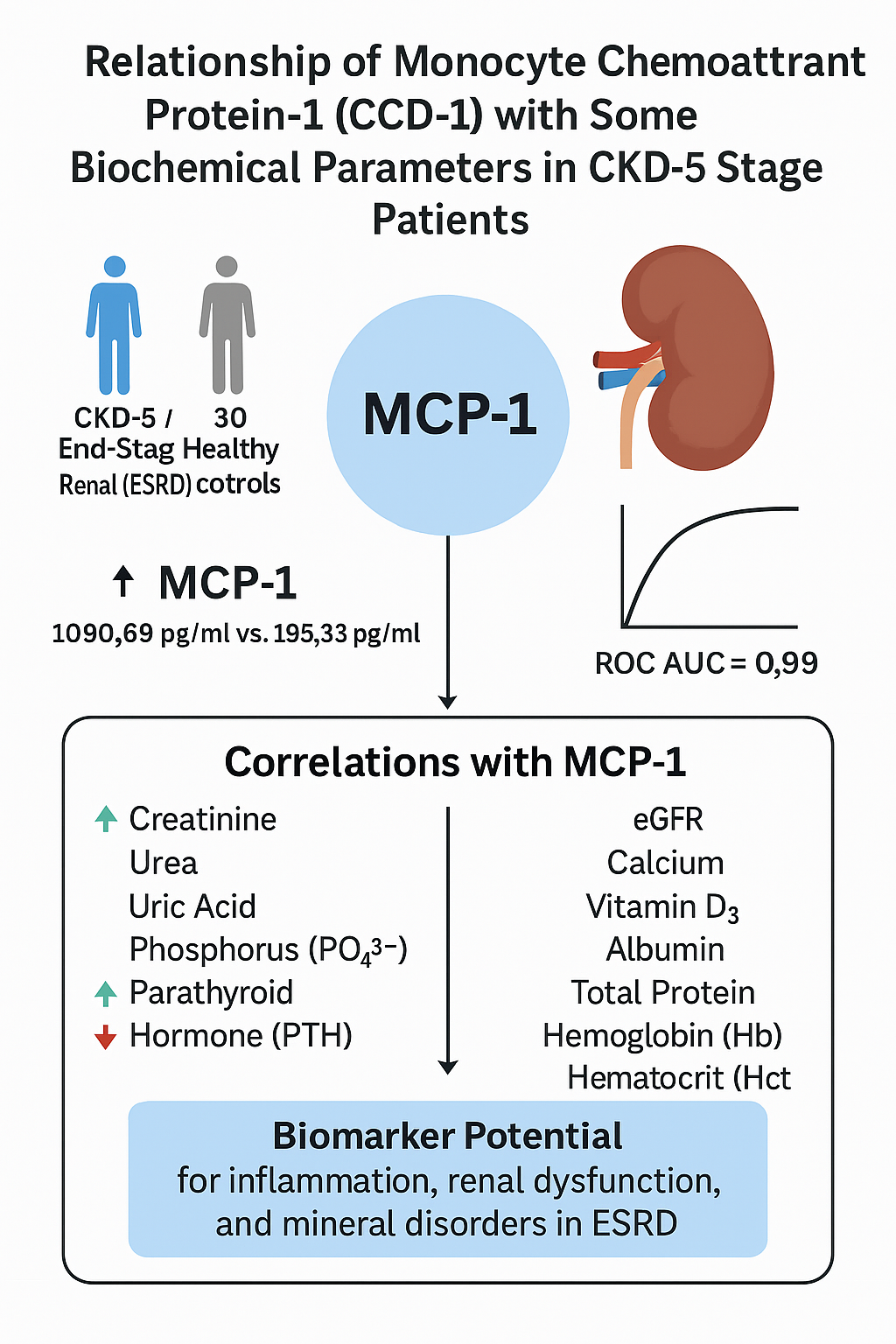
Results: MCP-1 levels were significantly elevated in ESRD, compared to controls (1090.69 ± 465.04 pg/mL vs. 195.33 ± 95.19 pg/mL, P < 0.0001). MCP-1 correlated positively with creatinine, urea, uric acid, phosphorus, and parathyroid hormone, and negatively with estimated glomerular filtration rate, calcium, vitamin D3, albumin, total protein, hemoglobin, and hematocrit
(P < 0.01). ROC analysis revealed excellent diagnostic accuracy (area under curve: 0.99), with sensitivity = 94.8%, specificity = 96.7%, and an optimal cut-off of 382.5 pg/mL.
Conclusion: MCP-1 is markedly elevated in ESRD and strongly associated with renal dysfunction, mineral imbalance, and inflammation. Its high diagnostic accuracy supports its role as a candidate biomarker in advanced CKD, although larger prospective studies are needed to confirm prognostic value and therapeutic implications.
Downloads
Additional Files
Published
Issue
Section
Categories
License
Copyright (c) 2026 Saif Bashar Mohammed, Hameed Hussein Ali, Amer Jihad Hussein

This work is licensed under a Creative Commons Attribution 4.0 International License.
The authors retain all proprietary rights, including copyright, such as patent and trademark rights and rights to any process or procedure described in the article.