Evaluation of Antibacterial Effects of Aqueous Extract of Retama reteam Plant Against MRSA at Different Seasons
DOI:
https://doi.org/10.47419/bjbabs.v7i1.411Keywords:
R. raetam, MRSA, Flavonoids, Antibacterial, SeasonalAbstract
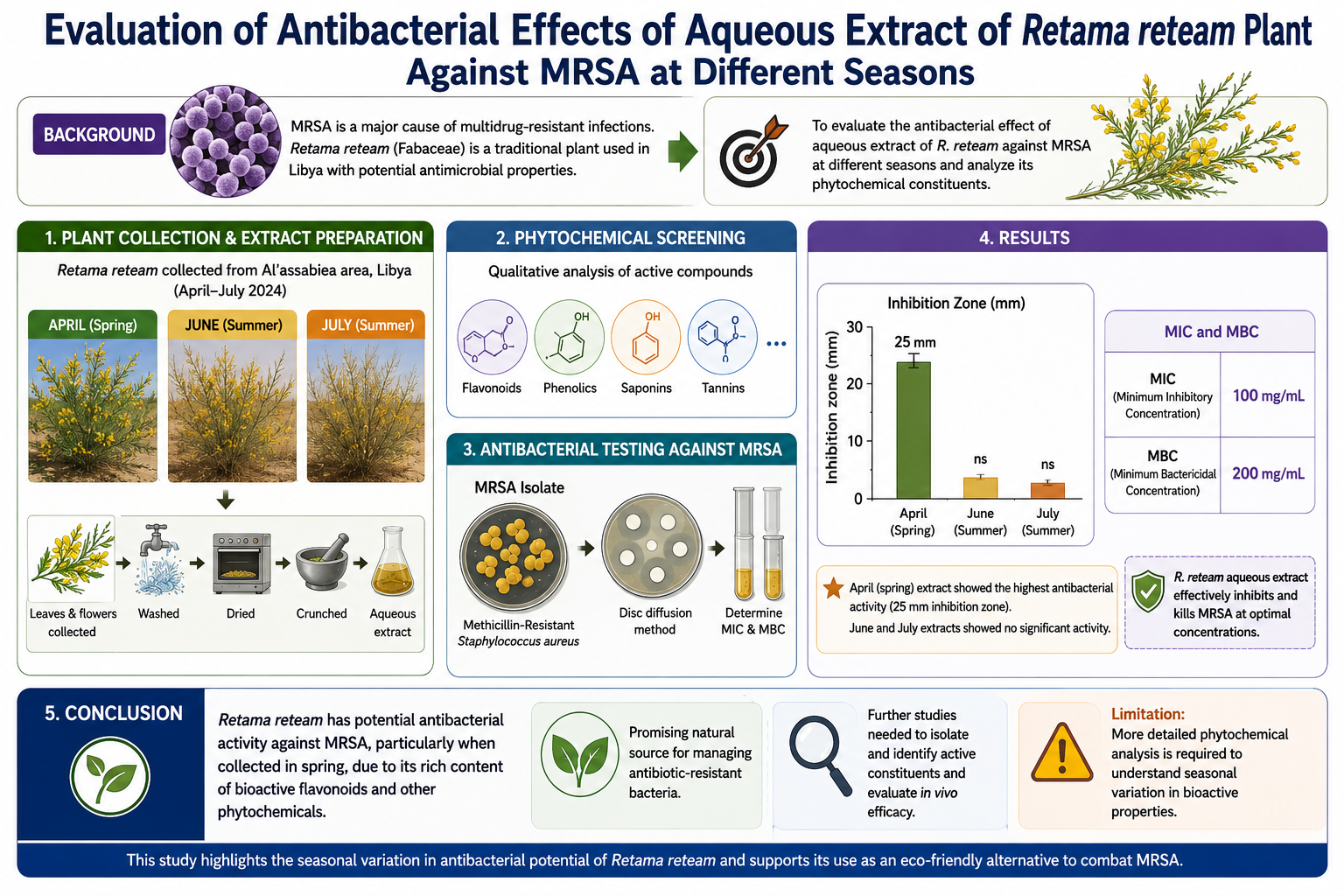
Background: The increasing incidence of multidrug-resistant infections, particularly methicillin-resistant Staphylococcus aureus (MRSA), is a significant global health challenge that warrants the exploration of alternative antimicrobial agents. This research studied the effectiveness of the aqueous extract of the R. raetam plant, from the family Fabaceae, against MRSA, with a focus on the effectiveness of plant compounds according to seasonal variation. The research aims to qualitatively analyze the active compounds of the plant and evaluate the effectiveness of these compounds on methicillin-resistant bacterial isolates in different seasons.
Methodology: The leaves and flowers of the plant were collected from the Al’assabiea area of Libya in April–July 2024. These were washed, dried, and crunched to prepare an aqueous extract. The plant parts were screened phytochemically to determine active ingredients. Disc diffusion method was used to determine the antibacterial activity of plant parts against MRSA. Minimum inhibitory concentration (MIC) and minimum bacterial concentration (MBC) were
determined.
Results: The results showed that the plant extracts studied in April were highly effective, reaching 25 mm inhibition zone, while the extracts studied in June and July did not produce significant results. The MIC and MBC values were determined to be 100 mg/mL and 200 mg/mL, respectively, indicating the extract’s potential to inhibit and destroy MRSA at these concentrations. Thus, R. raetam has potential antibacterial activity against MRSA, especially when collected in the spring, because it contains sufficient bioactive flavonoids that affect bacteria.
Conclusion: The findings show R. raetam as a potential natural source for managing antibiotic-resistant bacteria. Further studies are recommended to isolate and identify active constituents accountable for antibacterial activity, and evaluate their efficacy in vivo. Limitations of the study are the need for a more detailed phytochemical analysis to understand seasonal variations in bioactive properties of the plant.
Downloads
Additional Files
Published
Issue
Section
Categories
License
Copyright (c) 2026 Ali Abeid, Asma Abobakr Dera, Manahl Emhmed Abugseaa, Marn Ayad Abozakhar, Marn Suliman Abodaia, Reem Khalid Aljerbi

This work is licensed under a Creative Commons Attribution 4.0 International License.
The authors retain all proprietary rights, including copyright, such as patent and trademark rights and rights to any process or procedure described in the article.