Thermophilic Bacillus-Derived Lipase for Biodegradation of Lipid-Rich Industrial Waste, Enzyme Kinetics, Multivariate Culture Optimization, and Reactor Simulation
DOI:
https://doi.org/10.47419/bjbabs.v7i1.348Keywords:
Microbial lipases, Enzyme purification, thermophilic lipaseAbstract
Background: Thermophilic enzymes are considered essential and important in many industries that require high temperatures or alkaline environments such as biodiesel production and waste treatment.
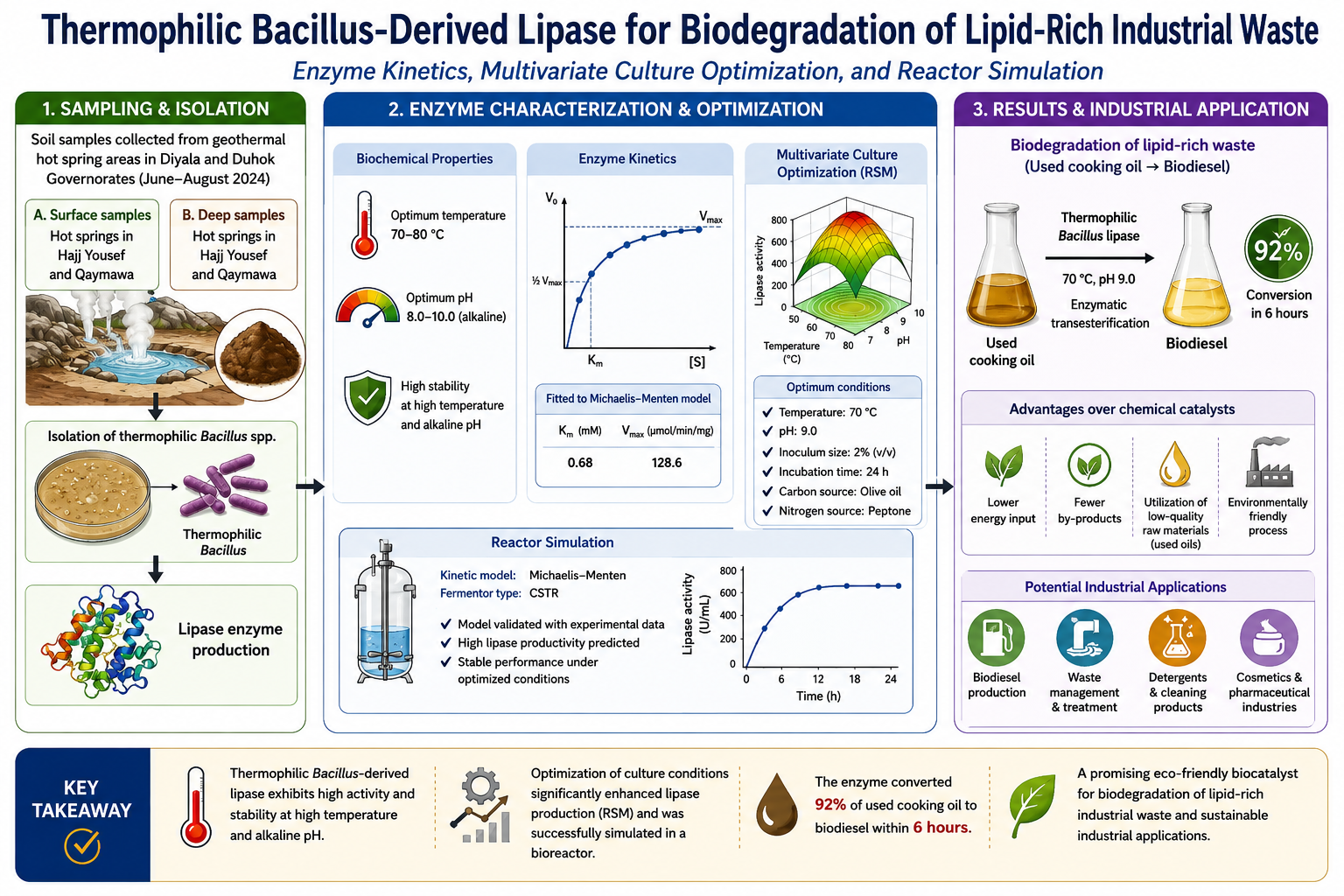
Aims: The research focuses on studying the biochemical properties of the lipase enzyme isolated from thermophiles microorganisms, which shows distinctive properties in terms of stability and activity at high temperatures and alkaline environments, making it suitable for many important industrial applications such as biodiesel production and waste management.
Study design: Soil samples were collected from different areas in Diyala Governorate and Duhok Governorate, especially soils close to a geothermal source (hot springs in Mosul and Qaymawa districts) during the beginning of summer for a period of 3 months (from June to the end of August 2024).
Methodology: Different soil samples were collected from different depths (surface, deep soil) including: (A) Surface samples (hot springs in Hajj Yousef and Qaymawa); (B) Deep samples (hot springs in Hajj Yousef and Qaymawa).
Results: The results indicate that this enzyme represents a promising option for industrial applications that require efficient biocatalysts capable of operating under harsh operating conditions. The conversion rate of 92% of used cooking oil to biodiesel in 6 hours by the enzyme demonstrates its efficiency as a biocatalyst. Compared to conventional chemical catalysts, the
enzyme offers advantages such as lower energy input, fewer by-products, and the ability to
utilize low-quality raw materials such as used oils.
Downloads
Additional Files
Published
Issue
Section
Categories
License
Copyright (c) 2026 Ziyad K. Radeef, Safaa Alloul H., Shahd Ab. Mohammed

This work is licensed under a Creative Commons Attribution 4.0 International License.
The authors retain all proprietary rights, including copyright, such as patent and trademark rights and rights to any process or procedure described in the article.